









Why do darknet markets keep returning after major seizures? Explore how demand, technology, vendor reputation, and law enforcement shape the evolution of the darknet ecosystem.
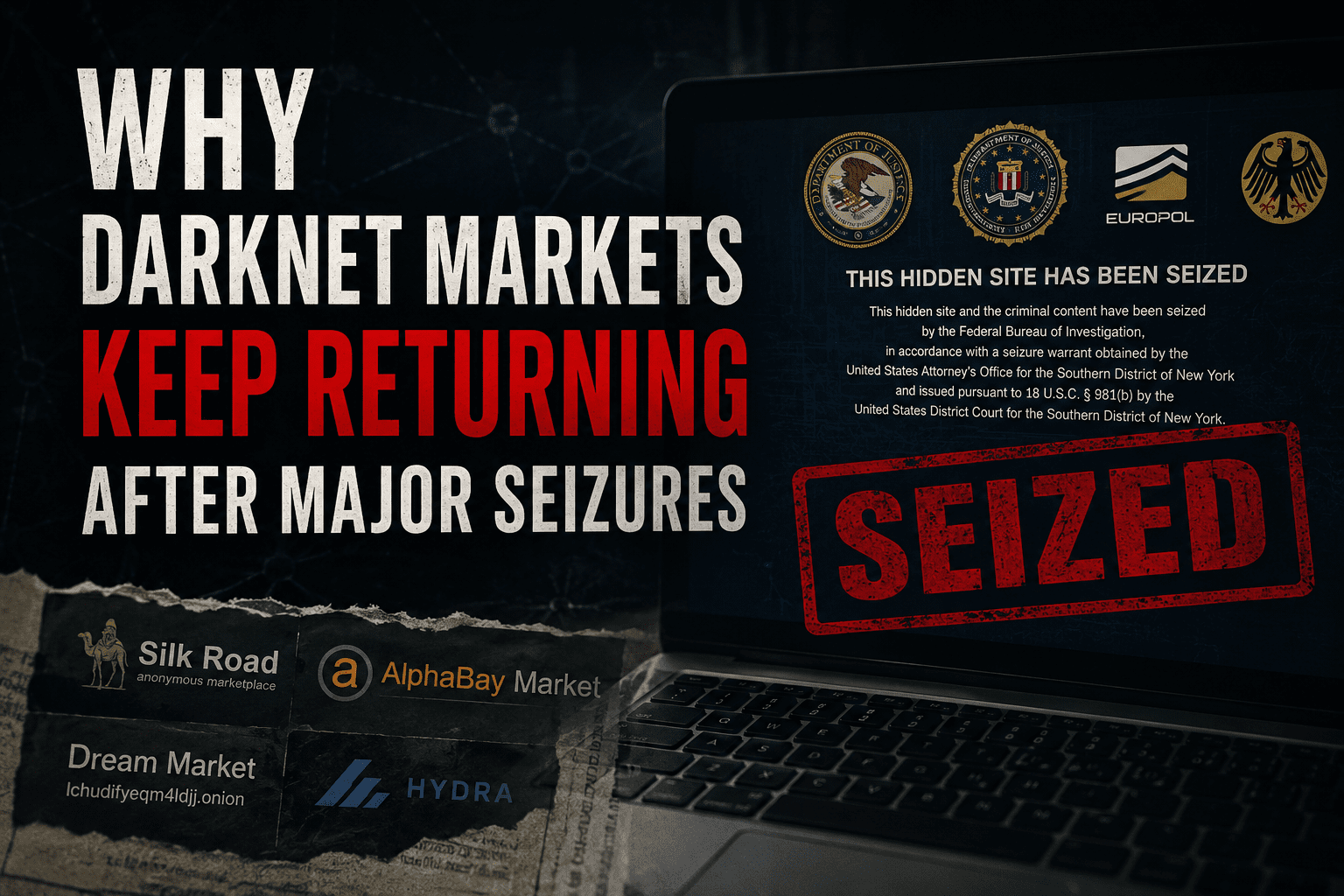
For more than a decade, law enforcement agencies around the world have pursued darknet marketplaces through coordinated international investigations. These operations have resulted in seized servers, confiscated cryptocurrency worth hundreds of millions of dollars, and the arrests of marketplace administrators, vendors, and buyers alike.
From the FBI’s takedown of Silk Road in 2013 to the seizure of Hydra Market in 2022, these investigations have demonstrated that anonymity technologies such as Tor do not make online criminal enterprises untouchable. Time and again, investigators have shown that operational security mistakes, blockchain analysis, undercover operations, and international cooperation can expose even the largest darknet platforms.
Each successful operation has disrupted illegal trade, generated valuable intelligence, and, in many cases, led to additional arrests long after a marketplace itself had disappeared. Yet despite these successes, one pattern has remained remarkably consistent.
New darknet marketplaces continue to emerge.
Some survive only a matter of months before disappearing. Others grow into major platforms hosting tens of thousands of listings and facilitating millions of dollars in cryptocurrency transactions before meeting the same fate as their predecessors. This recurring cycle raises an important question.
If major darknet marketplaces continue to be dismantled, why does the ecosystem itself continue to recover?
The answer is more complicated than simply saying that “another market replaces the old one.” Instead, it reflects the interaction between economics, technology, reputation, and the ongoing adaptation of both criminal networks and the investigators working to dismantle them.
Understanding that relationship offers valuable insight into how the darknet marketplace ecosystem has evolved over the past decade and why each major seizure leaves behind a landscape that looks different from the one before it.
A Decade of Market Takedowns
The modern darknet marketplace ecosystem has been shaped by a series of high-profile investigations.
Each operation disrupted criminal activity and demonstrated that no marketplace is immune from law enforcement. Yet each also marked the beginning of a new chapter rather than the end of the story.
Silk Road (2013)
The FBI’s seizure of Silk Road marked the first major turning point in darknet marketplace history. At the time, many believed its closure would permanently discourage similar platforms from emerging.
Instead of ending anonymous online marketplaces, however, Silk Road demonstrated that demand already existed. Within months, several new marketplaces appeared, each attempting to improve on its predecessor while avoiding the mistakes that led to its downfall.
Related: The Rise and Fall of Silk Road
AlphaBay (2017)
By 2017, AlphaBay had become the largest darknet marketplace ever created.
The operation represented one of the biggest victories against darknet crime to date. Yet despite AlphaBay’s enormous size, vendors and buyers rapidly migrated to competing platforms, demonstrating how resilient the marketplace ecosystem had become.
Related: The Rise and Fall of AlphaBay
Dream Market (2019)
Unlike many of its predecessors, Dream Market announced its own closure after years of operation amid increasing law enforcement pressure and persistent technical attacks.
Although the circumstances differed from previous seizures, the outcome was familiar.
Thousands of buyers and vendors began searching for alternatives almost immediately.
Hydra Market (2022)
Hydra Market dominated the Russian-speaking darknet for years before German authorities seized its infrastructure in 2022.
At the time, Europol described Hydra as:
“The world’s largest and longest-running darknet market.”
The seizure disrupted billions of dollars in cryptocurrency transactions and dealt a significant blow to Russian-language darknet commerce.
Related: The Rise and Fall of Hydra Market
Demand Doesn’t Disappear
Perhaps the simplest explanation is also the most important.
Marketplaces exist because they connect buyers and sellers. Removing a website may interrupt those transactions, but it does not automatically eliminate the demand that created the marketplace in the first place.
As long as individuals continue seeking illicit goods or services and others remain willing to supply them there is an incentive for replacement platforms to emerge. This pattern is not unique to darknet markets.
History is filled with examples of criminal organizations adapting after enforcement action. Participants change, methods evolve, and new networks emerge to replace those that were disrupted.
Darknet marketplaces follow much the same pattern. Law enforcement may remove the infrastructure, but the economic incentives often remain. That creates an opportunity for new operators willing to assume the considerable risks involved in running a marketplace.
Reputation is Portable
One of the defining characteristics of successful darknet marketplaces is trust. Unlike conventional e-commerce websites, anonymous transactions offer very little protection if something goes wrong. Buyers cannot simply contact customer support or request a credit card chargeback.
Instead, reputation becomes one of the most valuable assets a vendor can possess. Experienced vendors often spend years building positive feedback, establishing relationships with customers, and demonstrating reliability. Importantly, that reputation does not necessarily disappear when a marketplace does.
Many long-established vendors maintain the same PGP key across multiple platforms. By signing announcements or migration messages using that key, they can prove that the same individual has moved to a new marketplace.
Customers who recognize the signature are far more likely to continue doing business with a vendor they already trust. Vendors are often able to carry their reputation with them even when an entire marketplace disappears overnight.
This significantly reduces the time needed to rebuild a customer base and helps explain why experienced sellers often reappear quickly after a major takedown.
Technology Makes Starting Over Easier
The first generation of darknet marketplaces faced a number of technical challenges.
Administrators had to build marketplaces from scratch, solve payment processing issues, implement escrow systems, defend against attacks, and manage complex server infrastructure with relatively little precedent to follow.
Today, that landscape looks very different.
Open-source marketplace software, mature Tor infrastructure, cryptocurrency payment systems, encrypted communications, and years of publicly available operational knowledge have dramatically lowered many of the technical barriers that early administrators faced.
Launching a marketplace is still a complex and high-risk undertaking. Administrators must maintain infrastructure, resolve disputes, protect sensitive data, defend against denial-of-service attacks, and avoid operational security mistakes over extended periods.
Nevertheless, the technical foundations already exist. Each generation of marketplace operators benefits from lessons both successful and unsuccessful learned by those who came before.
That accumulated knowledge makes it easier for new marketplaces to emerge after older ones disappear.
Every Seizure Changes the Ecosystem
Although darknet marketplaces continue to reappear, they rarely return in the same form.
Each major investigation has changed how marketplaces operate, how vendors build trust, and how law enforcement approaches future investigations.
Silk Road demonstrated that marketplace administrators themselves could become investigation targets. Before its seizure, many believed Tor provided an almost impenetrable layer of anonymity. The FBI’s investigation showed that technology alone could not protect someone who made operational security mistakes.
AlphaBay reinforced that lesson. Rather than exploiting a weakness in Tor, investigators identified administrator Alexandre Cazes through a series of mistakes made outside the marketplace itself. Those mistakes ultimately proved far more valuable than any technical vulnerability.
Hydra demonstrated something different. Rather than eliminating Russian-language darknet commerce, its seizure fragmented the ecosystem across several competing marketplaces. Instead of one dominant platform, activity became distributed among multiple smaller services, making the overall landscape more decentralized than before.
The pattern repeats throughout darknet history.
Each major takedown removes a marketplace, but it also influences the design of whatever comes next.
- Operators study previous investigations.
- Developers introduce new security features.
- Users become more cautious.
- Investigators refine their techniques.
The ecosystem continues to evolve because both sides are constantly learning from previous operations.
Law Enforcement Has Adapted
It would be incorrect to suggest that darknet markets continue to exist because law enforcement has failed. If anything, the opposite is true. Modern investigations have become significantly more sophisticated than they were a decade ago.
Rather than relying solely on technical vulnerabilities, authorities increasingly combine blockchain analysis, digital forensics, undercover operations, financial intelligence, international cooperation, and traditional investigative work.
Cryptocurrency transactions that once appeared anonymous can often be traced through sophisticated blockchain analysis. Undercover investigators infiltrate marketplaces over extended periods. Server infrastructure may be seized, while intelligence gathered during one operation frequently contributes to future investigations.
This evolution has significantly increased the risks faced by marketplace administrators.
Several marketplace administrators once believed to be anonymous were ultimately identified through seemingly minor operational security mistakes. Mistakes that accumulated over months or years until investigators could connect them to a real-world identity.
Perfect anonymity is extraordinarily difficult to maintain over long periods. The longer a marketplace operates, the greater the opportunity for investigators to identify weaknesses.
The Human Factor
One lesson appears repeatedly throughout darknet investigations.
Technology rarely fails first. People do.
Many of the largest investigations have ultimately succeeded because administrators reused an email address, exposed identifying information during early development, reused usernames, left metadata behind, or made financial transactions that investigators could later connect to their real identities.
Cybersecurity professionals often refer to people as the weakest link in any security system. Darknet marketplaces are no exception.
No matter how sophisticated the technology becomes, maintaining flawless operational security for years at a time is an extraordinarily difficult task.
Eventually, small mistakes can become significant investigative leads.
Exit Scams Continue to Shape the Ecosystem
Not every marketplace disappears because of law enforcement. Some simply disappear because the administrators choose to leave with users’ funds.
Exit scams have become one of the defining risks of darknet marketplaces.
In these situations, administrators abruptly close a marketplace while retaining cryptocurrency held in escrow, leaving buyers and vendors with substantial financial losses.
For users, the consequences can be difficult to distinguish from a law enforcement seizure.
- A marketplace suddenly goes offline.
- Administrators stop communicating.
- Withdrawals fail.
- Rumours spread rapidly across forums.
- Only later does the community begin piecing together what actually happened.
- This uncertainty has changed user behaviour considerably over the years.
- Buyers have become increasingly cautious about leaving funds on marketplaces.
- Vendors often encourage direct communication through encrypted messaging platforms.
Some marketplaces have introduced multi-signature escrow or shorter holding periods in an attempt to reduce the risks associated with administrator-controlled wallets.
Ironically, exit scams have arguably done as much to undermine trust within the darknet ecosystem as law enforcement operations themselves.
From Giant Marketplaces to Fragmented Communities
One of the most significant changes over the past decade has been the gradual fragmentation of the ecosystem.
Earlier generations were dominated by one or two major marketplaces. Today, the landscape looks very different. Instead of relying on a single dominant platform, activity is spread across multiple smaller marketplaces, encrypted messaging applications, independent vendor stores, and invitation-only communities.
There are several reasons for this shift.
- Large marketplaces attract attention.
- They process greater transaction volumes.
- They become attractive targets for investigators.
- They also require complex infrastructure capable of supporting hundreds of thousands of users.
- Smaller communities operate differently.
While they generally serve fewer users, they also distribute activity across multiple independent platforms. The result is a more decentralized ecosystem where no single seizure has quite the same impact it once did.
Whether this trend continues remains uncertain, but it represents one of the most significant developments since the fall of Silk Road.
A Constant Cycle of Adaptation
Looking back over the past decade, one theme appears again and again.
Every major seizure changes the rules.
- Law enforcement develops new investigative techniques.
- Marketplace operators modify their security practices.
- Vendors become more selective.
- Buyers become more cautious.
- Developers introduce new features intended to address weaknesses exposed by previous investigations.
- Neither side remains static.
- Each operation influences the next.
This continual process of adaptation explains why the darknet marketplace ecosystem has never remained unchanged for very long.
It also explains why predicting its future has become increasingly difficult.
Predicting the future of darknet marketplaces is difficult. New technologies, changing law enforcement strategies, and shifts in user behaviour continue to reshape the ecosystem. Whether future marketplaces become smaller, more decentralized, or take entirely different forms remains to be seen. What history makes clear, however, is that every major seizure changes the landscape. The contest between investigators and marketplace operators is not a static one, it is an ongoing process of adaptation, where each side learns from the successes and failures of the other.
Related articles :
- Best Darknet Markets of 2026
- Interview with Pentester Cyberjagu
- FBI Informant Helped Run Dark Web Drug Market Incognito
Reports are sourced from official documents, law-enforcement updates, and credible investigations.
Discover additional reports, market trends, crime analysis and Harm Reduction articles on DarkDotWeb to stay informed about the latest dark web operations.